40th ICPC
ICPC 2016
Phuket, Thailand · 13 problems
- 1St. Petersburg State University · SPb SU 1: BaseAlexey Gordeev, Igor Pyshkin, Stanislav Ershov11
- 2Shanghai Jiao Tong University · DreadnoughtHaobin Ni, Wenhan Huang, Yanpei Liu11
- 3Harvard University · HarvardCalvin Deng, Johnny Ho, Scott Wu10
Problems
13 problemsProblem A · Balanced Diet Time limit: 2 seconds
Every day, Danny buys one sweet from the candy store and eats it. The store has types of sweets, numbered from to . Danny knows that a balanced diet is important and is applying this concept to his sweet purchasing. To each sweet type , he has assigned a target fraction, which is a real number (). He wants the fraction of sweets of type among all sweets he has eaten to be roughly equal to . To be more precise, let denote the number of sweets of type that Danny has eaten, and let . We say the set of sweets is balanced if for every we have
Danny has been buying and eating sweets for a while and during this entire time the set of sweets has been balanced. He is now wondering how many more sweets he can buy while still fulfilling this condition. Given the target fractions and the sequence of sweets he has eaten so far, determine how many more sweets he can buy and eat so that at any time the set of sweets is balanced.
Input
The input consists of three lines. The first line contains two integers (), which is the number of types of sweets, and (), which is the number of sweets Danny has already eaten.
The second line contains positive integers . These numbers are proportional to , that is, . It is guaranteed that the sum of all is no larger than .
The third line contains integers (), where each denotes the type of sweet Danny bought and ate on the th day. It is guaranteed that every prefix of this sequence (including the whole sequence) is balanced.
Output
Display the maximum number of additional sweets that Danny can buy and eat while keeping his diet continuously balanced. If there is no upper limit on the number of sweets, display the word forever.
Sample Input 1
6 5
2 1 6 3 5 3
1 2 5 3 5
Sample Output 1
1Sample Input 2
6 4
2 1 6 3 5 3
1 2 5 3
Sample Output 2
foreverACM-ICPC World Finals 2016 Problem A: Balanced Diet
Problem B · Branch Assignment Time limit: 3 seconds
The Innovative Consumer Products Company (ICPC) is planning to start a top-secret project. This project consists of subprojects. There will be branches of ICPC involved in this project and ICPC wants to assign each branch to one of the subprojects. In other words, the branches will form disjoint groups, with each group in charge of a subproject.
At the end of each month, each branch will send a message to every other branch in its group (a different message to each branch). ICPC has a particular protocol for its communications. Each branch has a secret key known only to the branch and the ICPC headquarters. Assume branch wants to send a message to branch . Branch encrypts its message with its key . A trusted courier picks up this message from this branch and delivers it to the ICPC headquarters. Headquarters decrypts the message with key and re-encrypts it with key . The courier then delivers this newly encrypted message to branch , which decrypts it with its own key . For security reasons, a courier can carry only one message at a time.
Given a road network and the locations of branches and the headquarters in this network, your task is to determine the minimum total distance that the couriers will need to travel to deliver all the end-of-month messages, over all possible assignments of branches to subprojects.
Input
The first line of input contains four integers , , , and , where () is the number of intersections, () is the number of branches, () is the number of subprojects, and () is the number of roads. The intersections are numbered from through . The branches are at intersections through , and the headquarters is at intersection . Each of the next lines contains three integers , , and , indicating a one-way road from intersection to a different intersection () of length (). No ordered pair appears more than once, and from any intersection it is possible to reach every other intersection.
Output
Display the minimum total distance that the couriers will need to travel.
ACM-ICPC World Finals 2016 Problem B: Branch Assignment
Sample Input 1
5 4 2 10
5 2 1
2 5 1
3 5 5
4 5 0
1 5 1
2 3 1
3 2 5
2 4 5
2 1 1
3 4 2
Sample Output 1
13Sample Input 2
5 4 2 10
5 2 1
2 5 1
3 5 5
4 5 10
1 5 1
2 3 1
3 2 5
2 4 5
2 1 1
3 4 2
Sample Output 2
24ACM-ICPC World Finals 2016 Problem B: Branch Assignment
Problem C · Ceiling Function Time limit: 5 seconds
Advanced Ceiling Manufacturers (ACM) is analyzing the properties of its new series of Incredibly Collapse-Proof Ceilings (ICPCs). An ICPC consists of layers of material, each with a different value of collapse resistance (measured as a positive integer). The analysis ACM wants to run will take the collapse-resistance values of the layers, store them in a binary search tree, and check whether the shape of this tree in any way correlates with the quality of the whole construction. Because, well, why should it not?
To be precise, ACM takes the collapse-resistance values for the layers, ordered from the top layer to the bottom layer, and inserts them one-by-one into a tree. The rules for inserting a value are:
-
If the tree is empty, make the root of the tree.
-
If the tree is not empty, compare with the root of the tree. If is smaller, insert into the left subtree of the root, otherwise insert into the right subtree.
ACM has a set of ceiling prototypes it wants to analyze by trying to collapse them. It wants to take each group of ceiling prototypes that have trees of the same shape and analyze them together.
For example, assume ACM is considering five ceiling prototypes with three layers each, as described by Sample Input 1 and shown in Figure C.1. Notice that the first prototype’s top layer has collapse- resistance value 2, the middle layer has value 7, and the bottom layer has value 1. The second prototype has layers with collapse-resistance values of 3, 1, and 4 – and yet these two prototypes induce the same tree shape, so ACM will analyze them together.
Given a set of prototypes, your task is to determine how many different tree shapes they induce.
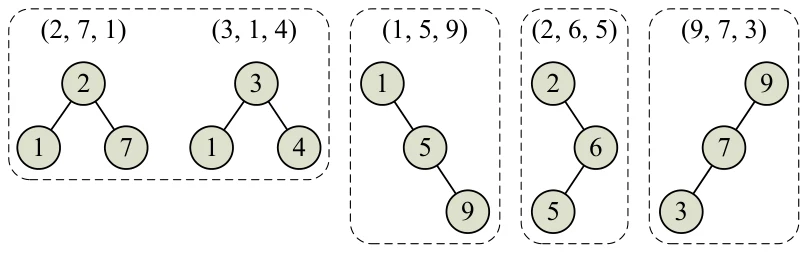
Figure C.1: The four tree shapes induced by the ceiling prototypes in Sample Input 1.
Input
The first line of the input contains two integers (), which is the number of ceiling prototypes to analyze, and (), which is the number of layers in each of the prototypes.
The next lines describe the ceiling prototypes. Each of these lines contains distinct integers (between and , inclusive), which are the collapse-resistance values of the layers in a ceiling prototype, ordered from top to bottom.
ACM-ICPC World Finals 2016 Problem C: Ceiling Function
Output
Display the number of different tree shapes.
Sample Input 1
5 3
2 7 1
3 1 4
1 5 9
2 6 5
9 7 3
Sample Output 1
4Sample Input 2
3 4
3 1 2 40000
3 4 2 1
33 42 17 23
Sample Output 2
2ACM-ICPC World Finals 2016 Problem C: Ceiling Function
-
Problem D · Clock Breaking Time limit: 5 seconds
After numerous unfortunate freak fatalities and the lawsuits, settlements, protests, and boycotts that naturally followed, the beleaguered executives at ACME Clock Manufacturers have decided they need to finally fix their disastrous quality control issues. It has been known for years that the digital clocks they manufacture have an unacceptably high ratio of faulty liquid-crystal display (LCD) screens, and yet these heartless souls have repeatedly failed to address the issue, or even warn their hapless consumers!
You have been called in as a quality consultant to finally put a stop to the madness. Your job is to write an automated program that can test a clock and find faults in its display.
These clocks use a standard 7-segment LCD display for all digits (shown on the left in Figure D.1), plus two small segments for the ‘:’, and show all times in a 24-hour format. The minute before midnight is 23:59, and midnight is 0:00. The ‘:’ segments of a working clock are on at all times. The representation of each digit using the seven segments is shown on the right in Figure D.1.

Figure D.1: LCD display of each digit.
Your program will be given the display of a clock at several consecutive minutes, although you do not know exactly what time these displays start. Some of the LCD segments are burnt out (permanently off) and some are burnt in (permanently on). Your program must determine, where possible, which segments are definitely malfunctioning and which are definitely in working order.
Input
The first input line contains a single integer (), which is the number of consecutive minutes of a clock’s display. The next lines contain ASCII images of these clock displays of size , with a single blank line separating the representations.
All digit segments are represented by two characters, and each colon segment is represented by one character. The character ‘X’ indicates a segment that is on. The character ‘.’ indicates anything else (segments that are off or non-segment portions of the display). See the sample input/output for details; the first output shows every possible LCD segment along with the smaller segments used to represent the ‘:’. No clock representation has an ‘X’ in a non-segment position or only half of a segment showing.
Output
Display a ASCII image with a ‘0’ for every segment that is burnt out, a ‘1’ for every segment that is burnt in, a ‘W’ for every segment that is definitely working, and a ‘?’ for every segment for which the status cannot be determined. Use ‘.’ for non-segments. If the given displays cannot come from consecutive minutes, display impossible.
ACM-ICPC World Finals 2016 Problem D: Clock Breaking
Sample Input 1
3
......XX.....XX...XX.
.....X..X...X..X....X
.....X..X.X.X..X....X
.............XX...XX.
.....X..X......X.X..X
.....X..X......X.X..X
......XX.....XX...XX.
......XX.....XX...XX.
.....X..X...X..X....X
.....X..X.X.X..X....X
.............XX...XX.
.....X..X......X.X..X
.....X..X......X.X..X
......XX.....XX...XX.
.............XX...XX.
........X...X..X....X
........X.X.X..X....X
.............XX......
........X...X..X.X..X
........X...X..X.X..X
......XX.....XX...XX.
Sample Output 1
.??...WW.....??...??.
?..?.W..?...?..1.0..?
?..?.W..?.?.?..1.0..?
.??...??.....11...WW.
?..?.W..?.0.W..?.1..?
?..?.W..?...W..?.1..?
.??...11.....??...??.
Sample Input 2
2
......XX.....XX...XX.
...X....X...X..X.X..X
...X....X.X.X..X.X..X
......XX..........XX.
...X.X....X.X..X.X..X
...X.X......X..X.X..X
......XX.....XX...XX.
......XX.....XX......
...X....X...X..X.....
...X....X.X.X..X.....
......XX.............
...X.X....X.X..X.....
...X.X......X..X.....
......XX.....XX......
Sample Output 2
impossibleACM-ICPC World Finals 2016 Problem D: Clock Breaking
Problem E · Forever Young Time limit: 1 second
My birthday is coming up. Alas, I am getting old and would like to feel young again. Fortunately, I have come up with an excellent way of feeling younger: if I write my age as a number in an appropriately chosen base , then it appears to be smaller. For instance, suppose my age in base is . Written in base it is only !
However, I cannot choose an arbitrary base when doing this. If my age written in base contains digits other than to , then it will be obvious that I am cheating, which defeats the purpose. In addition, if my age written in base is too small then it would again be obvious that I am cheating.
Given my age and a lower bound on how small I want my age to appear, find the largest base such that written in base contains only decimal digits, and is at least when interpreted as a number in base .
Input
The input consists of a single line containing two base 10 integers ( – yes, I am very old) and ().
Output
Display the largest base as described above.
Sample Input 1
32 20Sample Output 1
16Sample Input 2
2016 100Sample Output 2
42ACM-ICPC World Finals 2016 Problem E: Forever Young
Problem F · Longest Rivers Time limit: 10 seconds
The Chao Phraya River System. Picture from Wikimedia Commons. The Chao Phraya River System is the main river system of Thailand. Its six longest rivers listed by decreasing length are:
-
Tha Chin ( km)
-
Nan ( km)
-
Yom ( km)
-
Ping ( km)
-
Pa Sak ( km)
-
Wang ( km)
A simplified model of this river system is shown in Figure F.1, where the smaller red numbers indicate the lengths of various sections of each river. The point where two or more rivers meet as they flow downstream is called a confluence. Confluences are labeled with the larger black numbers. In this model, each river either ends at a confluence or flows into the sea, which is labeled with the special confluence number . When two or more rivers meet at a confluence (other than confluence ), the resulting merged river takes the name of one of those rivers. For example, the Ping and the Wang meet at confluence with the resulting merged river retaining the name Ping. With this naming, the Ping has length km while the Wang is only km. If instead the merged river had been named Wang, then the length of the Wang would be km while the length of the Ping would be only km.
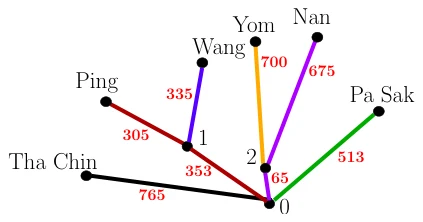
Figure F.1: The river system in Sample Input 1. Same-colored edges indicate a river.
The raised awareness of this phenomenon causes bitter rivalries among the towns along the rivers. For example, the townspeople along the Wang protest that maybe with a proper naming scheme, their river could actually be the longest, or maybe the second longest (or at least not last!). To end all the guessing, your task is to validate all such claims.
The rank of a river is its position in a list of all rivers ordered by decreasing length, where the best rank is for the longest river. For each river, determine its best possible rank over all naming schemes. At any confluence, the name of a new, larger river in any naming scheme must be one of the names of the smaller rivers which join at that confluence. If two or more rivers have equal lengths in a naming scheme, all the tied rivers are considered to have the best possible ranking. For example, if one river is the longest and all other rivers are equal, those rivers all have rank .
ACM-ICPC World Finals 2016 Problem F: Longest Rivers
Input
The first line of input contains two integers , which is the number of river sources in the system, and , which is the number of confluences with positive labels. These confluences are numbered from to .
The next lines describe the rivers. Each of these lines consists of a string, which is the name of the river at the source, and two integers and , where is the identifier of the nearest confluence downstream, and is the distance from the source to that confluence in kilometers. River names use only lowercase and uppercase letters a–z, and consist of between and characters, inclusive.
The final lines describe confluences to in a similar fashion. The th of these lines describes the confluence with identifier and contains two integers: the identifier of the nearest confluence down- stream and the distance from confluence to this confluence in kilometers.
It is guaranteed that each confluence through appears as “the nearest downstream” at least twice, confluence appears at least once, and all sources are connected to confluence .
Output
Display one river per line in the same order as in the input. On that line, display the name of the river and its best possible rank.
Sample Input 1
6 2
PaSak 0 513
Nan 2 675
Yom 2 700
Wang 1 335
Ping 1 305
ThaChin 0 765
0 353
0 65
Sample Output 1
PaSak 5
Nan 2
Yom 1
Wang 3
Ping 4
ThaChin 1
ACM-ICPC World Finals 2016 Problem F: Longest Rivers
-
Problem G · Oil Time limit: 10 seconds
A large part of the world economy depends on oil, which is why research into new methods for finding and extracting oil is still active. Profits of oil companies depend in part on how efficiently they can drill for oil. The International Crude Petroleum Consortium (ICPC) hopes that extensive computer simulations will make it easier to determine how to drill oil wells in the best possible way.
Drilling oil wells optimally is getting harder each day – the newly discovered oil deposits often do not form a single body, but are split into many parts. The ICPC is currently concerned with stratified
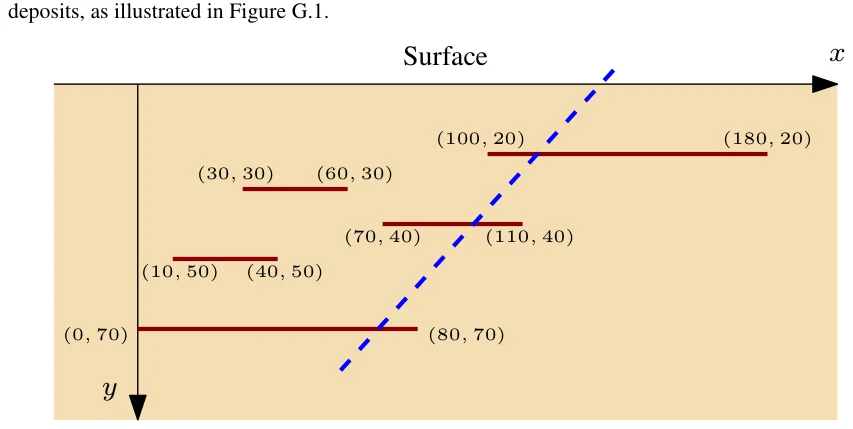
Figure G.1: Oil layers buried in the earth. This figure corresponds to Sample Input 1.
To simplify its analysis, the ICPC considers only the 2-dimensional case, where oil deposits are modeled as horizontal line segments parallel to the earth’s surface. The ICPC wants to know how to place a single oil well to extract the maximum amount of oil. The oil well is drilled from the surface along a straight line and can extract oil from all deposits that it intersects on its way down, even if the intersection is at an endpoint of a deposit. One such well is shown as a dashed line in Figure G.1, hitting three deposits. In this simple model the amount of oil contained in a deposit is equal to the width of the deposit. Can you help the ICPC determine the maximum amount of oil that can be extracted by a single well?
Input
The first line of input contains a single integer (), which is the number of oil deposits. This is followed by lines, each describing a single deposit. These lines contain three integers , , and giving the deposit’s position as the line segment with endpoints and . These numbers satisfy and . No two deposits will intersect, not even at a point.
Output
Display the maximum amount of oil that can be extracted by a single oil well.
ACM-ICPC World Finals 2016 Problem G: Oil
Sample Input 1
5
100 180 20
30 60 30
70 110 40
10 40 50
0 80 70
Sample Output 1
200Sample Input 2
3
50 60 10
-42 -42 20
25 0 10
Sample Output 2
25ACM-ICPC World Finals 2016 Problem G: Oil
Problem H · Polygonal Puzzle Time limit: 20 seconds
During last year’s ACM ICPC World Finals in Marrakesh, one of the judges bought a pretty wooden puzzle depicting a camel and palm trees (see Figure H.1). Unlike traditional jigsaw puzzles, which are usually created by cutting up an existing rectangular picture, all the pieces of this puzzle have been cut and painted separately. As a result, adjacent pieces often do not share common picture elements or colors. Moreover, the resulting picture itself is irregularly shaped. Given these properties, the shape of individual pieces is often the only possible way to tell where each piece should be placed.
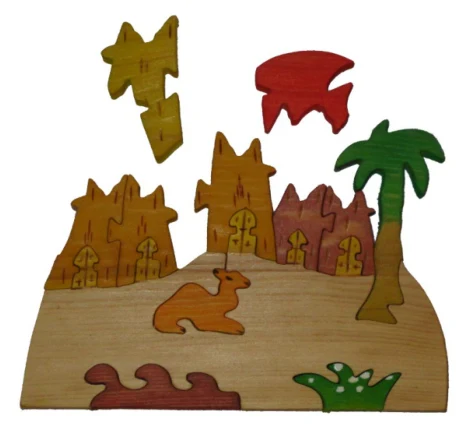
Figure H.1: The judge’s wooden puzzle.
The judge has been wondering ever since last year whether it is possible to write a program to solve this puzzle. An important part of such a program is a method to evaluate how well two puzzle pieces “match” each other. The better the match, the more likely it is that those pieces are adjacent in the puzzle.
Pieces are modeled as simple polygons. Your task is to find a placement of two given polygons such that their interiors do not overlap but the polygons touch with their boundaries and the length of the common boundary is maximized. For this placement, polygons can be translated and rotated, but not reflected or resized. Figure H.2 illustrates the optimal placement for Sample Input 1.
Input
The input contains the description of two polygons, one after the other. Each polygon description starts with a line containing an integer () denoting the number of vertices of the polygon. This is followed by lines, each containing two integer coordinates , of a polygon vertex (). The vertices of each polygon are given in clockwise order, and no three consecutive vertices are collinear.
The input data is chosen so that even if the vertices were moved by a distance of up to , the answer would not increase by more than .
ACM-ICPC World Finals 2016 Problem H: Polygonal Puzzle
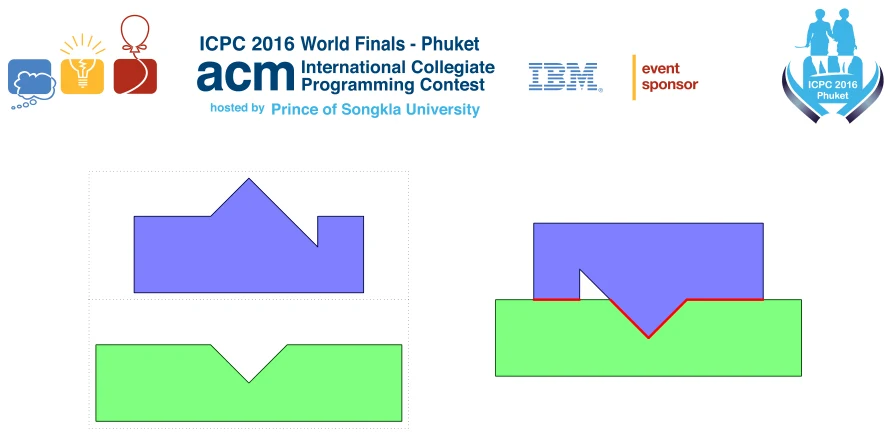
Figure H.2: Sample Input 1 and its optimal placement.
Output
Display the maximum possible length of the common boundary of these polygons when they are opti- mally placed. Your answer should have an absolute or relative error of less than .
Sample Input 1
8
0 0
0 10
10 10
15 15
24 6
24 10
30 10
30 0
7
-5 0
-5 10
10 10
15 5
20 10
35 10
35 0
Sample Output 1
30.142135624Sample Input 2
3
1 0
0 30
40 0
3
1 0
0 30
40 0
Sample Output 2
50ACM-ICPC World Finals 2016 Problem H: Polygonal Puzzle
Problem I · Road Times Time limit: 5 seconds
Ubol Narongdid is the founder of a brash new startup company called Special D-Liver-E. She wants to corner the market on overnight deliveries of organs between hospitals in the Phuket area. For scheduling purposes it is important to have accurate estimates for the times to perform such deliveries. Several trips between various hospitals have already been performed, so delivery times between those pairs of hospitals are known. The company currently has software to estimate times for other (as yet untraveled) trips, but so far all the estimates have been woefully inaccurate.
You have been asked to come up with a method to improve these estimates. You have at your disposal the following information: 1) the length (in kilometers) of the roads connecting each pair of cities in the Phuket area, and 2) a set of times (in minutes) for various previously executed deliveries.
You know that roads are one-way, and each road has a fixed speed limit that lies between and kilometers per hour. Speed limits are real-valued and need not be integers. You also know that delivery trucks always take the route that minimizes distance traveled, and on each road will always travel at a constant speed equal to that road’s speed limit. Thus you know, for example, that if a given trip is kilometers, the time it will take is between and minutes inclusive, in the absence of any other information. Ah, but you do have other information, namely the times of previous deliveries. It is up to you to use it to produce the best possible estimates.
Input
The input starts with a line containing an integer () indicating the number of cities, numbered to . After that are lines each containing integers specifying the distance in kilometers between cities: the th value on the th line indicates the distance when traveling directly from city to city . A value of indicates there is no road directly connecting the two cities, and the distance from any city to itself is always ; all other distances are positive and at most . There are at most roads.
Following this is a line with a single integer () indicating the number of previously executed routes. The next lines each contain three integers , , and , where and are the source and destination cities and is how long the delivery from to took, in minutes.
Finally there is a line containing a single integer () indicating the number of future delivery queries. The next lines each contain two integers and giving the source and destination cities for the query.
You may assume that for each of the source/destination pairs in the input there is a unique minimum- distance route.
Output
Display a single line for each query containing the source and destination cities for that query, followed by the best low and high bounds on the estimate for the travel time, accurate to within an absolute or relative error of .
ACM-ICPC World Finals 2016 Problem I: Road Times
Sample Input 1
3
0 50 -1
55 0 40
-1 40 0
1
0 2 120
3
0 1
1 2
1 0
Sample Output 1
0 1 50.0 80.0
1 2 40.0 70.0
1 0 55.0 110.0
ACM-ICPC World Finals 2016 Problem I: Road Times
Problem J · Spin Doctor Time limit: 5 seconds
As an employee of the world’s most respected political polling corporation, you must take complex, real- world issues and simplify them down to a few numbers. It isn’t always easy. A big election is coming up and, at the request of Candidate X, you have just finished polling people. You have gathered three pieces of information from each person, with the values for the th person recorded as:
-
– the number of digits of they have memorized
-
– the number of hairs on their head
-
– whether they will vote for Candidate X
Unfortunately, you are beginning to wonder if these are really the most relevant questions to ask. In fact, you cannot see any correlation between , , and in the data. Of course, you cannot just contradict your customer – that is a good way to lose your job!
Perhaps the answer is to find some weighting formula to make the results look meaningful. You will pick two real values and , and sort the poll results by the measure . The sort will look best if the results having true are clustered as close to each other as possible. More precisely, if and are the indices of the first and last results with true, you want to minimize the cluster size which is . Note that some choices of and will result in ties among the triples. When this happens, you should assume the worst possible ordering occurs (that which maximizes the cluster size for this pair).
Input
The input starts with a line containing (), which is the number of people polled. This is followed by one line for each person polled. Each of those lines contains integers ( ), (), and , where is if the person will vote for Candidate X and otherwise. The input is guaranteed to contain at least one person who will vote for Candidate X.
Output
Display the smallest possible cluster size over all possible pairs.
Sample Input 1
6
0 10 0
10 0 1
12 8 1
5 5 0
11 2 1
11 3 0
Sample Output 1
4ACM-ICPC World Finals 2016 Problem J: Spin Doctor
Sample Input 2
10
6 1 1
0 2 0
2 1 1
6 1 1
8 2 0
4 4 0
4 0 0
2 3 1
6 1 0
6 3 1
Sample Output 2
8Sample Input 3
5
5 7 0
3 4 0
5 7 0
5 7 1
9 4 0
Sample Output 3
1ACM-ICPC World Finals 2016 Problem J: Spin Doctor
-
Problem K · String Theory Time limit: 2 seconds
Nested quotations are great not only for writing literature with a complex narrative structure, but also in programming languages. While it may seem necessary to use different quotation marks at different nesting levels for clarity, there is an alternative. We can display various nesting levels using -quotations, which are defined as follows.
A -quotation is a string that begins with a quote character, ends with another quote character and contains no quote characters in-between. These are just the usual (unnested) quotations. For example, 'this is a string' is a -quotation.
For , a -quotation is a string that begins with quote characters, ends with another quote characters and contains a nested string in-between. The nested string is a non-empty sequence of -quotations, which may be preceded, separated, and/or succeeded by any number of non-quote characters. For example, ''All 'work' and no 'play''' is a -quotation.
Given a description of a string, you must determine its maximum possible nesting level.
Input
The input consists of two lines. The first line contains an integer (). The second line contains integers (), which describe a string as follows. The string starts with quote characters, which are followed by a positive number of non-quote characters, which are followed by quote characters, which are followed by a positive number of non-quote characters, and so on, until the string ends with quote characters.
Output
Display the largest number such that a string described by the input is a -quotation. If there is no such , display no quotation instead.
Sample Input 1
5
2 1 1 1 3
Sample Output 1
2Sample Input 2
1
22
Sample Output 2
4Sample Input 3
1
1
Sample Output 3
no quotationACM-ICPC World Finals 2016 Problem K: String Theory
Problem L · Swap Space Time limit: 6 seconds
You administer a large cluster of computers with hard drives that use various file system types to store data. You recently decided to unify the file systems to the same type. That is quite a challenge since all the drives are currently in use, all of them are filled with important data to the limits of their capacities, and you cannot afford to lose any of the data. Moreover, reformatting a drive to use a new file system may significantly change the drive’s capacity. To make the reformat possible, you will have to buy an extra hard drive. Obviously, you want to save money by minimizing the size of such extra storage.
You can reformat the drives in any order. Prior to reformatting a drive, you must move all data from that drive to one or more other drives, splitting the data if necessary. After a drive is reformatted, you can immediately start using it to store data from other drives. It is not necessary to put all the data on the same drives they originally started on – in fact, this might even be impossible if some of the drives have smaller capacity with the new file system. It is also allowed for some data to end up on the extra drive.
As an example, suppose you have four drives , , , and with drive capacities , , , and GB. Under the new file system, the capacities become , , , and GB, respectively. If you buy only GB of extra space, you can move the data from drive there and then reformat drive . Now you have GB free on drive , so you can move the GB from drive there and reformat drive . Finally, you move the six total gigabytes from drives and to drive , and reformat and .
Input
The input begins with a line containing one integer (), which is the number of drives in your cluster. Following this are lines, each describing a drive as two integers and , where is the capacity with the old file system and is the capacity with the new file system.
All capacities are given in gigabytes and satisfy . (One thousand petabytes should be enough for everyone, right?)
Output
Display the total extra capacity in gigabytes you must buy to reformat the drives.
Sample Input 1
4
6 6
1 7
3 5
3 5
Sample Output 1
1ACM-ICPC World Finals 2016 Problem L: Swap Space
Sample Input 2
4
2 2
3 3
5 1
5 10
Sample Output 2
5ACM-ICPC World Finals 2016 Problem L: Swap Space
Problem M · What Really Happened on Mars? Time limit: 2 seconds
Real-time software in the Mars Pathfinder spacecraft suffered from an issue known as priority inversion. One technique to address this issue is to use the Priority Ceiling Protocol.
In this problem, you will simulate the execution of multiple tasks according to this protocol. The tasks share a collection of resources, each of which can be used by only one task at a time. To ensure this, resources must be locked before use and unlocked after use. Each task is defined by a start time, a unique base priority, and a sequence of instructions. Each task also has a current priority, which may change during execution. Instructions come in three types:
-
compute – perform a computation for one microsecond
-
lock – lock resource (which takes no processor time)
-
unlock – unlock resource (which takes no processor time)
After locking a resource, a task is said to own the resource until the task unlocks it. A task will unlock only the owned resource it most recently locked, will not lock a resource it already owns, and will complete with no owned resources.
Each resource has a fixed priority ceiling, which is the highest base priority of any task that contains an instruction to lock that resource.
There is a single processor that executes the tasks. When the processor starts, it initializes its clock to zero and then runs an infinite loop with the following steps:
Step 1. Identify running tasks. A task is running if its start time is less than or equal to the current processor clock and not all of its instructions have been executed.
Step 2. Determine the current priorities of the running tasks and which of the running tasks are blocked. A running task is blocked if the next instruction in is to lock resource and either resource is already owned or at least one other task owns a resource whose priority ceiling is greater than or equal to the current priority of . If is blocked, it is said to be blocked by every task owning such or . The current priority of a task is the maximum of ’s base priority and the current priorities of all tasks that blocks.
Step 3. Execute the next instruction of the non-blocked running task (if any) with the highest current priority. If there was no such task or if a compute instruction was executed, increment the proces- sor clock by one microsecond. If a lock or unlock instruction was executed, do not increment the clock.
The Priority Ceiling Protocol defined above has the following properties:
-
Current priority is defined in terms of current priority and blocking, and blocking is defined in terms of current priority. While this may appear circular, there will always be a unique set of current priorities that satisfy the definitions.
-
All tasks will eventually complete.
-
There will never be a tie in step 3.
ACM-ICPC World Finals 2016 Problem M: What Really Happened on Mars?
Input
The first line of the input contains two integers , which is the number of tasks, and (), which is the number of resources. This is followed by lines, where the th of these lines describes task . The description of a task begins with three integers: the task’s start time (), its base priority (), and an integer (). A task description is concluded by a sequence of strings describing the instructions. Each string is a letter (C or L or U) followed by an integer. The string C () indicates a sequence of compute instructions. The strings L and U () indicate instructions locking and unlocking resource respectively.
No two tasks have the same base priority.
Output
For each task, display the time it completes execution, in the same order that the tasks are given in the input.
Sample Input 1
3 1
50 2 5 C1 L1 C1 U1 C1
1 1 5 C1 L1 C100 U1 C1
70 3 1 C1
Sample Output 1
106
107
71
Sample Input 2
3 3
5 3 5 C1 L1 C1 U1 C1
3 2 9 C1 L2 C1 L3 C1 U3 C1 U2 C1
1 1 9 C1 L3 C3 L2 C1 U2 C1 U3 C1
Sample Output 2
8
15
16
ACM-ICPC World Finals 2016 Problem M: What Really Happened on Mars?
-