46th ICPC
ICPC 2022
Luxor, Egypt · 11 problems
- 1Peking University · reborn as a vegetable dogLingyu Jiang, Yuxiang Luo, Zhanpeng Wang10
- 2Massachusetts Institute of Technology · MIT CopyPasteAnton Trygub, Mingyang Deng, Ziqian Zhong9
- 3National Research University Higher School of Economics · Undertrained+OverpressuredIvan Safonov, Maksim Gorokhovskii, Timofei Fedoseev9
Problems
11 problemsProblem P · Turning Red Time limit: 3 seconds
Mei’s parents have spent the last year remodeling their house, but their lighting system is quite complex! Each room in the house has an LED light, which can be set to red, green, or blue, as seen in Figure P.1.
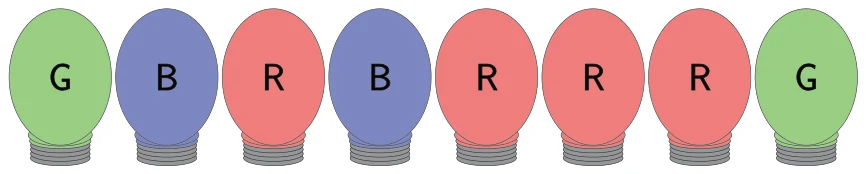
Figure P.1: The initial state of the lights in Sample Input 1. Buttons and wires not shown.
Throughout the house are various buttons which are each connected to one or more lights. When a button is pressed, any red lights connected to that button become green, any green lights connected to that button become blue, and any blue lights connected to that button become red. Each button can be pressed multiple times. Because the house was built prior to the invention of crossbar wiring, each light is controlled by at most two buttons.
Mei’s favorite color is red, so she wants to turn all of the lights red. Her parents, fearing the buttons will wear out, have asked her to minimize the total number of button presses.
Input
The first line of input contains two positive integers and , where () is the number of lights and () is the number of buttons. The second line of input is a string of characters, all either R, G, or B, where the th character is the initial color of the th light. The next lines describe the buttons. Each of these lines begins with an integer (), the number of lights controlled by this button. Then distinct integers follow, the lights controlled by this button. The lights are indexed from to , inclusive. Each light appears at most twice across all buttons.
Output
Output the minimum number of button presses Mei needs to turn all the lights red. If it is impossible for Mei to turn all of the lights red, output impossible.
Sample Input 1
8 6
GBRBRRRG
2 1 4
1 2
4 4 5 6 7
3 5 6 7
1 8
1 8
Sample Output 1
8Sample Input 2
4 3
RGBR
2 1 2
2 2 3
2 3 4
Sample Output 2
impossibleSample Input 3
4 4
GBRG
2 1 2
2 2 3
2 3 4
1 4
Sample Output 3
6Sample Input 4
3 3
RGB
1 1
1 2
1 3
Sample Output 4
3Problem Q · Doing the Container Shuffle Time limit: 2 seconds
Cargo containers by Martini171 via Wikimedia Commons, cc by-sa Majestic cargo ships, each carrying thousands of shipping con- tainers, roam the world’s seas every day. They make modern trade possible by being so efficient that shipping goods halfway around the world costs only pennies.
Once the ships reach their destination, their standard-size cargo containers are unloaded from the ship onto stacks on land, from which they are moved to trains or trucks that deliver them to their destination. It turns out that moving containers is expensive, so port operators try to minimize the number of moves necessary for delivering cargo.
In this problem, we consider such a container-unloading scenario. We need to unload containers, which are placed into two stacks built from bottom to top. The placement of each container is at random, with equal probability it will be put onto the first or the second stack (independently of other containers). Once all containers are unloaded, they will be picked up by trucks in a given order. When a truck wants to load a specific container, there are two cases. If the container is on top of its stack, then the container can be moved to the truck without moving any other containers. Otherwise, containers have to be moved from one stack to the other until the requested container is at the top of its stack. At that point the container can be moved onto the truck.
As an example, consider a case of three containers that arrive in order 1, 2, 3. Assume that 1 and 3 are in the first stack, and 2 is in the second. If the containers are moved onto trucks in order 1, 2, 3, then five moves of containers have to take place:
Stack 1 Stack 2 Comment
1 3
       2
Initial configuration (stacks bottom to top)
1
       2 3
Move container 3 from stack 1 to stack 2
2 3Move container 1 to truck
3
       2
Move container 3 from stack 2 to stack 1
3Move container 2 to truck Move container 3 to truck
Table Q.1: Example moves of containers requested in order 1 2 3.
We want to know how many moves are necessary to deliver all containers to the customers. Assuming that container placement is random, we ask you to compute the expected number of moves necessary for a given truck-loading order.
Input
The first line of input contains an integer (), the number of containers. The containers are numbered , and are unloaded from the ship in this order. The second line of input contains integers . These numbers are a permutation of , and specify the order in which the containers are loaded onto trucks.
Output
Output the expected number of moves necessary to load the containers onto the trucks – this excludes the cost of unloading them from the ship, but includes both moves between stacks and from a stack to a truck. Your answer should have an absolute error of at most .
Sample Input 1
5
4 2 5 3 1
Sample Output 1
7.000Sample Input 2
6
1 2 3 4 5 6
Sample Output 2
13.500Problem R · Zoo Management Time limit: 5 seconds
A picture of a zoo with a camel, a donkey and (part of) a goat. When managing a zoo, you sometimes want to move the animals between enclosures. You might figure out that the zebras will enjoy the spacier enclosure currently occupied by the penguins, while the penguins might want to move to the colder enclosure where the koalas currently live; and koalas will move to an empty enclosure that can be filled up with eucalyptus. So, you would move the koalas first, to free up the colder enclosure, then move the penguins there, and finally move the zebras.
The way you move animals is by using special tunnels that con- nect the enclosures – you do not want the animals to move out- side, both because of the risk that they will be scared, and because of the risk that they might run away and hurt themselves.
Unfortunately, you have acquired more animals recently, and all the enclosures are now full, which makes moving animals around much harder. Imagine, for instance, that the koalas were to move to the former zebra enclosure – you cannot move any set of animals first. Instead, what you learned to do, is to move the animals at the same time – the zebras, koalas and penguins start moving down different tunnels at the same time, and arrive at their new enclosures at the same time – and thus they never meet. Note that you cannot just swap the animals in two connected enclosures this way (because they would meet in the tunnel and become scared).
So, now you have a puzzle. You have a list of enclosures, each with an animal type inside; some of those enclosures are connected by tunnels. You can, any number of times, choose some set of animals and move each one to an enclosure adjacent by tunnel, as long as the animal in that enclosure is also moved as the part of the same move, and no tunnel is used more than once as a part of the same move. You also have your vision of the perfect way to position the animals. Is it possible to do so, in a series of moves?
Input
The first line of the input consists of two integers () and (), indicating the number of enclosures and tunnels. Then follow lines, the th of which contains two integers () and (), indicating the type of animal that is in enclosure at the beginning, and the type of animal that you want to be in enclosure after all the moves. You may assume that is a permutation of .
Then follow lines describing the tunnels. Each line contains two integers and (), indicating that enclosures and are connected by a two-way tunnel. No two enclosures are connected by more than one tunnel.
Output
If it is possible to move the animals so that every enclosure contains the desired animal type, output possible. Otherwise, output impossible.
Sample Input 1
3 3
1 4
4 7
7 1
1 2
2 3
1 3
Sample Output 1
possibleSample Input 2
2 1
1 2
2 1
1 2
Sample Output 2
impossibleSample Input 3
5 6
10 40
20 30
30 50
40 20
50 10
1 2
2 3
1 3
3 4
3 5
4 5
Sample Output 3
possibleSample Input 4
4 4
10 10
10 20
20 10
20 20
1 2
2 3
3 4
1 4
Sample Output 4
impossibleProblem S · Bridging the Gap Time limit: 4 seconds
A bridge with low capacity A group of walkers arrives at a river in the night. They want to cross a bridge, which can hold a limited number of walkers at a time. The walkers have just one torch, which needs to be used when crossing the bridge. Each walker takes a certain time to cross; a group crossing together must walk at the slowest walker’s pace. What is the shortest time it takes for all walkers to cross the bridge?
For example, Sample Input 1 assumes the bridge can hold walkers at a time and there are walkers with crossing times minute, minutes, minutes and minutes, respectively. The shortest time of minutes can be achieved by the following sequence of crossings. First, the two fastest walkers cross in minutes. Second, the fastest walker crosses back in minute. Third, the two slowest walkers cross in minutes. Fourth, the second-fastest walker crosses back in minutes. Fifth, the two fastest walkers cross in minutes.
Input
The first line of input contains two integers and , where () is the number of walkers, and () is the number of walkers the bridge can hold at a time.
Then follows a line containing integers ( for all ). The th walker takes time to cross.
Output
Output the minimum total time it takes for the entire group to cross the bridge.
Sample Input 1
4 2
1 2 10 5
Sample Output 1
17Sample Input 2
4 6
1 2 10 5
Sample Output 2
10Problem T · Carl’s Vacation Time limit: 1 second
Carl the ant is back! After traversing meandering paths (Problem A, 2004 World Finals) and wandering over octahedrons (Problem C, 2009 World Finals) it is time for a little vacation – time to see the sights! And where better to see the sights than at the tips of tall structures like, say, pyramids!! And where better to see tall pyramids but Egypt!!! (This is so exciting!!!!!)
After taking in the view from the tip of one pyramid, Carl would like to go to the tip of another. Since ants do not do particularly well in the hot sun, he wants to find the minimum distance to travel between the tips of these two pyramids, assuming he can only walk on the surfaces of the pyramids and the plane which the pyramids sit upon. The pyramids are, geometrically, right square pyramids, meaning the apex of the pyramid lies directly above the center of a square base.
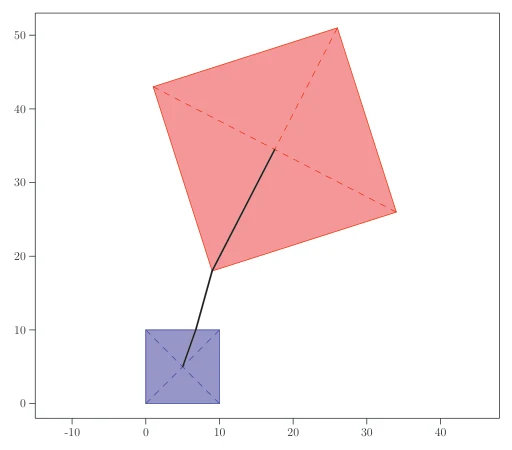
Figure T.1: Illustration of two pyramids corresponding to Sample Input 1. The black line shows the shortest path between their apexes.
Input
The first line of input contains five integers where ( and ) define an edge of the first pyramid, with the body of the pyramid lying to the left of the directed vector from to , and () is the height of the pyramid. The second line of input describes the second pyramid in the same format. The intersection of the bases of the two pyramids has area.
Output
Output the minimum distance Carl travels between the tips of the two pyramids. Your answer should have an absolute or relative error of at most .
Sample Input 1
0 0 10 0 4
9 18 34 26 42
Sample Output 1
60.866649532Problem U · Toy Train Tracks Time limit: 1 second
Model railroad by Marshman via Wikimedia Commons, cc by-sa Every little child, and quite a number of adults, are fascinated by toy trains. From a toddler’s choo-choo train to a hobbyist’s elabo- rate model railroad filling an entire basement, they are a profitable business. The Toy Train Tracks Construction Company (TTTCC) manufactures train tracks for all ages and skill levels. To keep their existing customers busy and maybe attract some new ones, the TTTCC has recently started publishing maps for how to con- nect their train tracks into elaborate layouts. Usually, this starts with a designer coming up with an interesting track layout, and then publishing both the layout and the required number of dif- ferent track segments (say, curves and straight parts) needed to construct it. But the TTTCC has recently learned that many customers are looking for the reverse: they already have train track segments lying around (maybe found in grandma’s attic), and would like to use them to create a large train course. How difficult might that be?
To study the feasibility of automating the layout-creation process, TTTCC is interested in constructing train courses using two different shapes: straight line segments, and -degree turns (see Figure U.1).

Figure U.1: A straight track segment and a curved track segment.
Valid layouts are created by placing these shapes on a square grid, with each track piece taking up exactly one grid cell. Both types of pieces can be rotated in -degree increments. A “proper” train track needs to be connected, and should form a single closed loop. Given a set of straight and curved track segments,
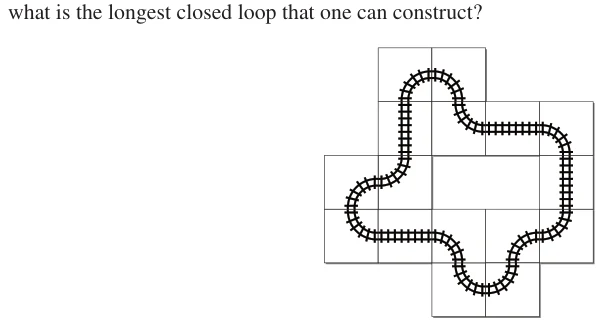
Figure U.2: A sample track using four straight track segments and twelve curves. This corresponds to Sample Output 1.
Input
The input consists of a single line containing two integers and , the number of straight and curved track segments available, respectively (, ).
Output
Output a train loop using at most straight segments and curved segments, that has the longest length (in number of track segments used) under this restriction. The loop must be closed and cannot intersect itself. If there are multiple loops of maximal length, any one of them will be accepted.
If the loop is of length , then print a single string of length , where the characters represent the loop’s segments as encountered in a single traversal. The character ‘S‘ stands for a straight-line segment, ‘L‘ for a curved segment that is a left turn, and ‘R’ for a curved segment that is a right turn.
Sample Input 1
4 12Sample Output 1
LSRLLRLSLSRLLSRLSample Input 2
1 5Sample Output 2
LLLLProblem V · Three Kinds of Dice Time limit: 1 second
Image from rawpixel, CC0 See how they roll! According to a famous story, Warren Buffett once challenged Bill Gates to a simple game of dice. He had three dice; the first player could examine them and choose one of the three. The second player would then choose one of the remaining dice, and both players would roll their dice against each other, aiming for the highest numbers. Warren offered to let Bill go first, but this made Bill suspicious so he opted to go second. It turned out to be a wise choice: these were intransitive dice. The first die had an advantage when rolling against the second, the second had an advantage when rolling against the third, but the first did not have an advantage when rolling against the third!
To formalize this: define a “die” as any shape with at least one face such that each face shows a positive integer. When a die is rolled, one of its faces is selected uniformly at random. When two dice roll against each other, the die whose selected face shows a higher number earns point; if both numbers are equal, each die earns points. For dice and , define as the expected number of points earns from a single roll against . If , we say that has an advantage over ; if , the two dice are tied. For example, if is the first die in the sample input and is the second, and , so has an advantage over .
Given two dice and such that has an advantage over , you want a third die that forms an intransitive trio with the other two. Among all that have an advantage over or tie with , compute the lowest possible . If this is less than , you can make an intransitive trio! Similarly, among all such that has an advantage over or ties with , compute the highest possible .
Input
The input contains two lines, each describing one die. One of the dice (the first or the second) has an advantage over the other. The die with the advantage is and the other is .
The first integer on a line gives (), the number of faces on the die. Then follow integers ( for each ), giving the integer on each face.
Output
Output one line containing the lowest and the highest under the above conditions. The two scores do not need to use the same die . Your answer should have an absolute error of at most .
Sample Input 1
6 1 1 6 6 8 8
3 2 4 9
Sample Output 1
0.291666667 0.750000000Sample Input 2
4 9 3 7 5
3 4 2 3
Sample Output 2
0.500000000 0.500000000Problem W · Riddle of the Sphinx Time limit: 2 seconds
Oedipus and the Sphinx by Gustave Moreau, 1864, public domain One of the most remarkable landmarks in Egypt is the Great Sphinx of Giza, a statue depicting a mythical creature with the head of a human, the body of a lion, and the wings of an eagle. Sphinxes were regarded as guardians in Egyptian and Greek mythologies. Probably the most famous sphinx is the one who guarded the Greek city of Thebes. According to myths, when Oedipus tried to enter the city, the sphinx gave him the follow- ing riddle: “Which creature has one voice, but has four feet in the morning, two feet in the afternoon, and three feet at night?” As you might have heard, Oedipus correctly answered, “Man
- who crawls on all fours as a baby, then walks on two feet as
an adult, and then uses a walking stick in old age.”
In this problem, you meet a different sphinx who gives you a somewhat reversed riddle: “How many legs do an axex, a basilisk, and a centaur have?” While you recognize these as creatures from Egyptian and Greek mythology, you have no clue how many legs each has (except that it is a nonnegative integer). The sphinx sternly instructs you to not touch anything so you are unable to search for the answer on your phone.
However, the sphinx allows you to ask her five questions. In each question you can ask the sphinx how many legs some num- ber of these creatures have in total. For instance, you could ask, “How many legs do three basilisks and one axex have in to- tal?” or “How many legs do five centaurs have?” Seems easy enough, you think, but then you remember that sphinxes are tricky creatures: one of the sphinx’s five answers might be an outright lie, and you do not know which one.
Write a program to talk to the sphinx, ask the five questions, and solve the riddle.
Interaction
There are exactly five rounds of questions. In each question round, you must first write a line containing three space-separated integers , , and (), representing the question “How many legs do axex, basilisks, and centaurs have in total?” After the question is asked, an input line containing a single integer () is available on standard input, giving the sphinx’s answer to your question.
After the five rounds of questions, output a line containing three space-separated nonnegative integers , , and , indicating the number of legs of an axex, a basilisk, and a centaur, respectively.
Read
Sample Interaction 1
Write
                             1 1 1
12
                             1 1 1
13
                             5 0 1
24
                             1 0 0
4
                             1 1 0
8
                             4 4 4
Read
Sample Interaction 2
Write
                             4 4 4
2023
                             1 0 0
0
                             0 1 0
42
                             0 0 1
2024
                             0 0 0
0
                             0 42 2024
Problem X · Quartets Time limit: 2 seconds
Four cards of a set, from a German Quartets deck by Wilhelm Busch via Wikimedia Commons, public domain You are watching a group of kids playing a friendly game of Quartets and having fun. At one moment, you started being sus- picious that some of the kids may be cheating. It seems the kids themselves are not bothered by that at all. Quite the contrary, this brings them even more fun, especially when someone gets caught cheating. As a programmer, you immediately started to think about ways to detect cheating by just observing their game.
Quartets is a -player card game that uses a deck of cards divided into sets of cards each. Actual cards often contain educational images, which helps players to learn not only in- dividual objects but also their classification. For example, the cards may display animals while the sets correspond to various groups of animals (mammals, reptiles, etc.).
At the beginning of a Quartets game, every player is dealt cards and player starts their turn. In each turn, a player asks another player whether they have one particular card. If the asked player has that card, they must give it to the requester, and the requester continues their turn by asking any of the players for another card. If the asked player does not possess the requested card, the re- questing player loses the turn and the asked player starts their turn. An important rule states that the requesting player must already have at least one card from the same set as the card they ask for.
If, during their turn, a player holds a full set (“quartet”) in their hand, the player may show the quartet to the other players, put it aside and gain one point. The four cards of the quartet are permanently removed from the current game. If at any point a player has no cards left, that player leaves the game. If it was that player’s turn, the turn passes to the next player in sequence (player -----) who still has any cards. If no players have any cards, the game ends and the player with the most points is declared the winner.
Players are not allowed to ask for cards that have been removed from the game, and they cannot ask for a card from a player who has left the game.
Cheating in the game of Quartets is conceivable in two situations where a player falsely claims to have (or not have) some card. Specifically, the cheating occurs if
-
a player asks for a card although they have no card of the corresponding set, or
-
a player being asked claims not to have the requested card although they have it.
Needless to say, cheating is often discovered later. Theoretically, a watchful opponent can eventually find out about any cheating, as all cards are finally revealed at some point before the game ends.
Note that asking for a card that the asked player cannot possibly have (for example, because the requester has it in their own hand) is not exactly a smart move but is not considered cheating by itself.
Input
The first line of input contains an integer (), the number of consecutive actions in one game of Quartets, starting from the beginning of a game. The next lines each contain a description of an action. Each action is described by one line and may be one of the following:
-
A yes – player asks player for the card , and player hands that card to player ;
-
A no – player asks player for the card , player claims not to have it, and starts their turn;
-
Q – player puts aside a quartet .
In all actions, and (, ) are integers denoting the players, () is a one- digit integer corresponding to one of the sets/quartets, and A B C D is a character identifying the four cards within a set. Thus the cards are labeled 1A, 1B, 1C, 1D, 2A, 2B, , 8C, 8D. The four cards that share the same first digit form a single set.
The given sequence describes a valid game being played among 4 players. That is, except for the two possible ways of cheating mentioned above, all actions satisfy all the rules.
Output
If there is a possible initial distribution of the cards such that the sequence of actions corresponds to a (possibly partial) game with all players following the rules, output yes. Otherwise, output no, followed by a line giving the number of the first action after which it is certain that some player must have cheated. Actions are numbered sequentially starting with 1, the actions of putting quartets aside are also counted.
Explanation of Sample Input 1
Players and both claim not having 3C, and neither of them had 3A or 3D. So one of them either lied about not having 3C, or asked for 3C without having 3B (the only remaining card from set ).
Sample Input 1
4
1 A 2 3C no
2 A 3 3A yes
2 A 4 3D yes
2 A 1 3C no
Sample Output 1
no
4
Sample Input 2
6
1 A 2 3C no
2 A 3 3A yes
2 A 4 3D yes
2 A 1 3B no
1 A 4 5B yes
1 Q 5
Sample Output 2
yes-
Problem Y · Compression Time limit: 1 second
Image adapted from Wikimedia Commons, public domain Infinite Compression Plan Consortium (ICPC) has developed a new, great data compression strategy, called “Don’t Repeat Your- self” (DRY). DRY works on a string of characters, and if the string contains two consecutive instances of the same substring, it simply removes one of them. For example, in the string “alfalfa seeds”, it could remove one of the two “e” sub- strings in “seeds”, and one of the two “lfa” substrings in “alfalfa”, resulting in “alfa seds”. DRY can also take advantage of previous removals – for instance, in the string “seventeenth baggage”, it will first remove the duplicate “e” in “seventeenth” and the duplicate “g” in “baggage”, resulting in “sevententh bagage”, and then remove the du- plicate “ent” in “sevententh” and “ag” in “bagage”, resulting in “seventh bage”.
If there are multiple choices of repeating consecutive substrings to remove, DRY should choose in a way that results in the shortest possible final string. For example, in the string “ABBCDCABCDCD”, DRY has two choices – either removing the repeated “B” near the beginning, or the repeated “CD” at the end. If the “B” is removed, then DRY will be able to remove the repeated “ABCDC”, resulting in “ABCDCD”, from which the “CD” at the end will finally be removed, resulting in “ABCD”. However, if DRY removed the “CD” at the end first, it would be left with “ABBCDCABCD”, from which only the repeated “B” can be removed to obtain “ABCDCABCD” – and from that string nothing more can be removed. So, the correct choice for DRY is to begin by compressing the double “B”, and to finally end up with “ABCD”.
ICPC observed that DRY obtains the best results on binary strings – that is, strings composed only of zeroes and ones. So, it has tasked you with implementing the best possible DRY algorithm working on binary strings. For any binary string, you should output a shortest string that can be obtained by repeatedly applying DRY to it.
Input
The input consists of a single line containing a nonempty string of length less than or equal to , consisting only of zeroes and ones.
Output
Output one line, containing a shortest possible result of running DRY on the input string. If there is more than one possible shortest result, any one will be accepted.
Sample Input 1
1111Sample Output 1
1Sample Input 2
101Sample Output 2
101Sample Input 3
10110Sample Output 3
10Problem Z · Archaeological Recovery Time limit: 1 second
Renowned professor of Egyptology Z Mummer is exploring a newly discovered tomb in Luxor where she finds a mysterious construction. On a wall, there is a row of pyramid-shaped stone slabs. Each stone features three hieroglyphs: an ankh (top), an eye of Horus (bottom left), and an ibis (bottom right).
Next to the wall there are levers. Cautiously experimenting with these, wary of potential traps, the professor realizes that each lever rotates some of the pyramids clockwise or counter-clockwise so that another hieroglyph is pointing upwards on them. Flipping back a lever rotates the same pyramids in the opposite direction back to their original position. The levers operate completely independently of each other, so flipping or unflipping a lever has the same effect regardless of what states the other levers are
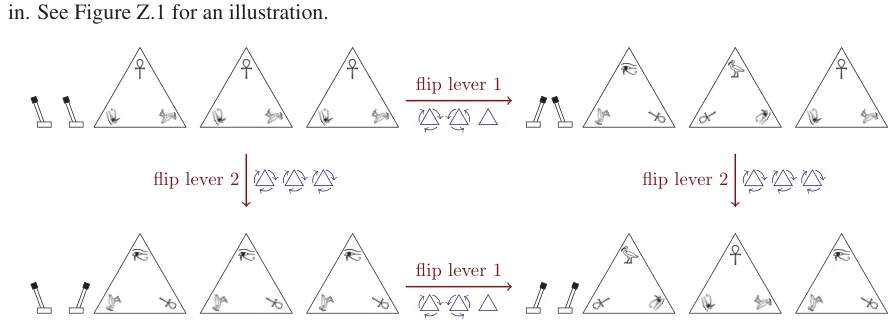
Figure Z.1: Illustration of a wall with pyramids and levers. The first lever rotates the first pyramid clockwise, the second pyramid counterclockwise, and leaves the third pyramid unchanged. The second lever rotates all three pyramids clockwise. This corresponds to Sample Input 1.
Intrigued, Professor Mummer records the individual effect of each lever. Back at her university after the expedition, she assigns one of her students the laborious task of figuring out all possible pyramid configurations (some of which may be identical) that can be achieved by flipping some subset of the levers, so that these can be studied further.
After many nights of careful calculations, the student is finally done and starts gathering his papers. But then disaster strikes: he accidentally spills some ink and completely destroys the professor’s original notes, which contained the only record of the individual effects of each lever.
The only chance to escape Professor Mummer’s wrath is to reconstruct the original notes from the list of possible pyramid configurations. This cannot be done completely unambiguously (for example, there is no way of distinguishing between different orderings of the same set of levers). But as long as the levers still result in the calculated list of pyramid configurations, this error is unlikely to be noticed (at least not until after the student has graduated).
Input
The first line of input contains three integers , and , where () and () are the number of levers and pyramids, respectively, and () is the number of different pyramid configurations. Then follow lines describing the distinct possible pyramid configurations. Each such line consists of a string of length describing the configuration and an integer () indicating the number of different lever settings which result in this configuration. The configuration is described using the letters ‘A’, ‘E’, and ‘I’. The th character indicates the hieroglyph facing upwards on the th pyramid: ‘A’ for ankh, ‘E’ for eye of Horus, and ‘I’ for ibis.
The configurations given are pairwise distinct, the sum of -values over all lines equals , and the input is such that at least one list of levers results in the given multiset of configurations.
Output
Output lines describing a possible set of levers that gives rise to the given multiset of pyramid config- urations. Each line describes one lever using a string of length consisting of the symbols ‘+’, ‘-’, or ‘0’. In each such string, the th symbol describes the action of this lever on the th pyramid: ‘+’ if the lever moves the pyramid clockwise, ‘-’ if the lever moves it counterclockwise, and ‘0’ if the lever does not move this pyramid.
If there is more than one possible solution, any one will be accepted.
Sample Input 1
2 3 4
EEE 1
EIA 1
IAE 1
AAA 1
Sample Output 1
+-0
+++
Sample Input 2
3 2 2
IA 4
AA 4
Sample Output 2
-0
00
00