43rd ICPC
ICPC 2019
Porto, Portugal · 11 problems
- 1Moscow State University · Moscow SU: Red PandaGrigory Reznikov, Mikhail Ipatov, Vladislav Makeev10
- 2Massachusetts Institute of Technology · MIT NULLAndrew He, Kevin Sun, Yinzhan Xu9
- 3The University of Tokyo · Gifted InfantsKohei Morita, Riku Kawasaki, Takuto Shigemura9
Problems
11 problemsProblem A · Azulejos Time limit: 10 seconds
Azulejo in the cathedral of Porto. Source: Wikimedia Commons Ceramic artists Maria and João are opening a small azulejo store in Porto. Azule- jos are the beautiful ceramic tiles for which Portugal is famous. Maria and João want to create an attractive window display, but, due to limited space in their shop, they must arrange their tile samples in two rows on a single shelf. Each of João’s tiles has exactly one of Maria’s tiles in front of it and each of Maria’s tiles has exactly one of João’s tiles behind it. These hand-crafted tiles are of many different sizes, and it is important that each tile in the back row is taller than the tile in front of it so that both are visible to passers-by. For the convenience of shoppers, tiles in each row are arranged in non-decreasing order of price from left to right. Tiles of the same price may be arranged in any order subject to the visibility condition stated above.
Your task is to find an ordering of the tiles in each row that satisfies these constraints, or determine that no such ordering exists.
Input
The first line of input contains an integer (), the number of tiles in each row. The next four lines contain integers each; the first pair of lines represents the back row of tiles and the second pair of lines represents the front row. Tiles in each row are numbered from to according to their ordering in the input. The first line in each pair contains integers ( for each ), where is the price of tile number in that row. The second line in each pair contains integers ( for each ), where is the height of tile number in that row.
Output
If there is a valid ordering, output it as two lines of integers, each consisting of a permutation of the tile numbers from to . The first line represents the ordering of the tiles in the back row and the second represents the ordering of the tiles in the front row. If more than one pair of permutations satisfies the constraints, any such pair will be accepted. If no ordering exists, output impossible.
Sample Input 1
3 2 1 2
2 3 4 3
2 1 2 1
2 2 1 3
Sample Output 1
3 2 4 1
4 2 1 3
Sample Input 2
1 2
2 3
2 8
2 1
Sample Output 2
impossibleICPC World Finals 2019 Problem A: Azulejos
Problem B · Beautiful Bridges Time limit: 10 seconds
Example of a Roman arch bridge. Source: Wikimedia Commons What connects us all? Well, it is often bridges. Since an- cient times, people have been building bridges for roads, for trains, for pedestrians, and as aqueducts to transport water. It is humanity’s way of not taking inconvenient geography for an answer.
The company Arch Bridges Construction (ABC) specializes in–you guessed it–the construction of arch bridges. This classical style of bridge is supported by pillars that extend from the ground below the bridge. Arches between pillars dis- tribute the bridge’s weight onto the adjacent pillars.
The bridges built by ABC often have pillars spaced at irregular intervals. For aesthetic reasons, ABC’s bridges always have semicircular arches, as illustrated in Figure B.1. However, while a bridge arch can touch the ground, it cannot extend below the ground. This makes some pillar placements impossible.
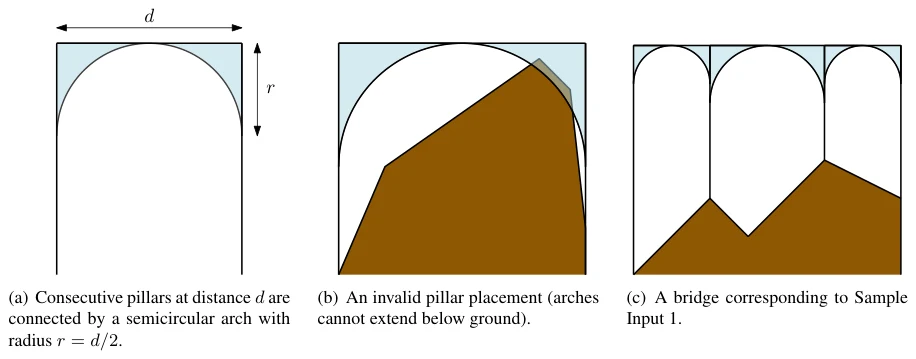
Figure B.1: Bridge examples.
Given a ground profile and a desired bridge height , there are usually many ways of building an arch bridge. We model the ground profile as a piecewise-linear function described by key points , where the -coordinate of a point is the position along the bridge, and the -coordinate is the elevation of the ground above sea level at this position along the bridge. The first and last pillars must be built at the first and last key points, and any intermediate pillars can be built only at these key points. The cost of a bridge is the cost of its pillars (which is proportional to their heights) plus the cost of its arches (which is proportional to the amount of material used). So a bridge with pillars of heights that are separated by horizontal distances has a total cost of
for some given constants and . ABC wants to construct each bridge at the lowest possible cost.
ICPC World Finals 2019 Problem B: Beautiful Bridges
Input
The first line of input contains four integers , , , and , where () is the number of points describing the ground profile, () is the desired height of the bridge above sea level, and , () are the cost factors as described earlier. Then follow lines, the th of which contains two integers , ( and ), describing the ground profile.
Output
Output the minimum cost of building a bridge from horizontal position to at height above sea level. If it is impossible to build any such bridge, output impossible.
Sample Input 1
5 60 18 2
0 0
20 20
30 10
50 30
70 20
Sample Output 1
6460Sample Input 2
4 10 1 1
0 0
1 9
9 9
10 0
Sample Output 2
impossibleICPC World Finals 2019 Problem B: Beautiful Bridges
Problem C · Checks Post Facto Time limit: 1 second
Your university’s board game club just hosted a Checkers tournament, and you were assigned to take notes on the games. Unfortunately, while walking home, you dropped all of your papers into a puddle! Disaster! Much of what you wrote is now unreadable; all you have left are some lists of moves played in the middle of various games. Is there some way you can reconstruct what happened in those games? You had better fix things fast, or they will demote you to Tic-Tac-Toe recordkeeper!
Checkers (or English Draughts) is a well-known board game with simple rules. It is played on the dark squares of an checkerboard. There are two players, Black and White, who alternate turns moving their pieces (all of Black’s pieces are black and all of White’s pieces are white). Each piece occupies a single dark square, and can be either a normal man or a promoted king. A turn consists of choosing one piece and moving it in one of two ways:
-
Shifting it diagonally to an unoccupied adjacent dark square, as shown in Figure C.1(a). This is called a simple move. If the piece is a man, it can move only in the two diagonal directions towards the opposing side of the board (towards the bottom for Black, the top for White). If the piece is a king, it can move in all four diagonal directions.
-
Jumping over an adjacent enemy piece to an unoccupied square immediately on the other side, then removing (capturing) that piece. Men can jump only in the two directions described above, while kings can jump in all four. The player can then repeat this step, continuing to jump with the same piece as long as there are properly-positioned enemy pieces to capture. Such a sequence of one or more jumps is called a jump move. Figure C.1(b) shows a jump move comprising three
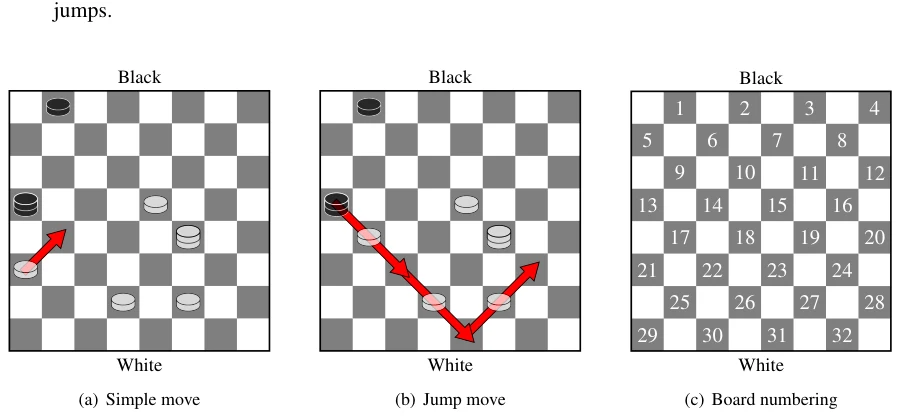
Figure C.1: (a), (b) The first two moves in Sample Input 1. The larger pieces are kings and the smaller ones are men. Black sits at the top and White at the bottom. (c) Numbering used in the input.
In Checkers, captures are forced moves. If a jump move is available at the start of a player’s turn, they must jump, and cannot stop jumping with that piece until it has no more possible jumps. They are free to choose which piece to jump with, and where, if there are multiple possibilities. In Figure C.1(b), Black could not have made any other move.
ICPC World Finals 2019 Problem C: Checks Post Facto If a man reaches the farthest row from its player (that is, a black man reaches the bottom row or a white man reaches the top row), it is removed from the board and replaced by a king of the same color (it is said to be promoted), and the turn ends. A piece cannot be promoted and then jump backwards as a new king in the same turn.
Given a list of moves, find a setup of pieces such that the moves can be legally played in sequence starting from that setup. This setup may not have black men on the bottom row or white men on the top row, since they would have been promoted to kings already. You need only ensure that the rules above are obeyed; you do not need to ensure that this setup is reachable in a real game of Checkers.
Input
The first line of input contains a character and an integer , where B W indicates which player makes the first move (Black or White respectively) and () is the number of moves in the list. Then follow lines, each of which describes a move in the standard Checkers notation defined below.
The dark squares are identified by numbers –, as shown in Figure C.1(c). A simple move from square to square is written as -. A jump move starting at and jumping to is written as xxx x.
There is always a valid solution for the given set of moves.
Output
Output two boards side-by-side (separated by a space), giving the positions of all pieces on the board before (on the left) and after (on the right) the given moves. Use ‘-’ for light squares, ‘.’ for empty dark squares, lowercase ‘b’ and ‘w’ for black and white men, and uppercase ‘B’ and ‘W’ for black and white kings. If there is more than one valid solution, any one is acceptable.
Sample Input 1
W 3
21-17
13x22x31x24
19x28
Sample Output 1
-b-.-.-. -b-.-.-.
.-.-.-.- .-.-.-.-
-.-.-.-. -.-.-.-.
B-.-w-.- .-.-w-.-
-.-.-W-. -.-.-.-.
w-.-.-.- .-.-.-.-
-.-w-w-. -.-.-.-W
.-.-.-.- .-.-.-.-
Sample Input 2
B 5
2-7
9x2
32-27
2x11x18
5-9
Sample Output 2
-.-b-.-W -.-.-.-W
b-b-.-.- .-.-.-.-
-w-.-.-. -b-.-.-.
B-w-b-.- B-w-.-.-
-.-.-.-. -.-W-.-.
.-.-.-.- .-.-.-.-
-.-.-.-. -.-.-B-.
.-.-.-B- .-.-.-.-
ICPC World Finals 2019 Problem C: Checks Post Facto
-
Problem D · Circular DNA Time limit: 3 seconds
You have an internship with a bioinformatics research group studying DNA. A single strand of DNA consists of many genes, which fall into different categories called gene types. Gene types are delimited by specific nucleotide sequences known as gene markers. Each gene type has a unique start marker s and a unique end marker e. After many dirty jobs (growing bacteria, cell extraction, protein engineering, and so on), your research group can convert DNA into a form consisting of only the gene markers, removing all the genetic material lying between the markers.
Your research group came up with the interesting hypothesis that gene interpretation depends on whether the markers of some gene types form properly nested structures. To decide whether markers of gene type form a proper nesting in a given sequence of markers , one needs to consider the subsequence of containing only the markers of gene type (s and e), leaving none of them out. The following (and only the following) are considered to be properly nested structures:
-
se
-
se, where is a properly nested structure
-
, where and are properly nested structures
Given your computing background, you were assigned to investigate this property, but there is one further complication. Your group is studying a specific type of DNA called circular DNA, which is DNA that forms a closed loop. To study nesting in circular DNA, it is necessary to cut the loop at some location, which results in a unique sequence of markers (the direction of reading is fixed by molecular properties). Whether a gene type forms a proper nesting now also depends on where the circular DNA is cut. Your task is to find the cutting location that maximizes the number of gene types that form a properly nested structure. Figure D.1 shows an example corresponding to Sample Input 1. The indicated cut results in the markers for gene type being properly nested.
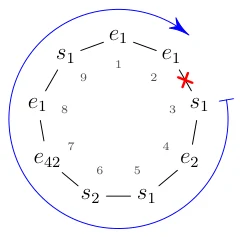
Figure D.1: Illustration of Sample Input 1 with its optimal cutting location.
Input
The first line of input contains an integer (), the length of the DNA. The next line contains the DNA sequence, that is, markers. Each marker is a character followed by an integer , where s e specifies whether it is a start or an end marker and () is the gene type of the marker. The given DNA sequence has been obtained from the circular DNA by cutting at an arbitrary location.
ICPC World Finals 2019 Problem D: Circular DNA
Output
Output one line with two integers and , where is the cutting position that maximizes the number of different gene types that form a proper nesting, and is this maximum number of gene types. The DNA is cut just before the th input marker (for instance, the cut shown in Figure D.1 has ). If more than one cutting position yields the same maximum value of , output the smallest that does so.
Sample Input 1
9
e1 e1 s1 e2 s1 s2 e42 e1 s1
Sample Output 1
3 1Sample Input 2
8
s1 s1 e3 e1 s3 e1 e3 s3
Sample Output 2
8 2ICPC World Finals 2019 Problem D: Circular DNA
-
Problem E · Dead-End Detector Time limit: 5 seconds
A dead-end sign. Source: Wikimedia Commons The council of your home town has decided to improve road sign placement, especially for dead ends. They have given you a road map, and you must determine where to put up signs to mark the dead ends. They want you to use as few signs as possible.
The road map is a collection of locations connected by two-way streets. The following rule describes how to obtain a complete placement of dead-end signs. Consider a street connecting a location with another location. The -entrance of gets a dead-end sign if, after entering from , it is not possible to come back to without making a U-turn. A U-turn is a - degree turn immediately reversing the direction.
To save costs, you have decided not to install redundant dead-end signs, as specified by the following rule. Consider a street with a dead-end sign at its -entrance and another street with a dead-end sign at its -entrance. If, after entering from , it is possible to go to and enter without making a U-turn, the dead-end sign at the -entrance of is redundant. See Figure E.1 for examples.
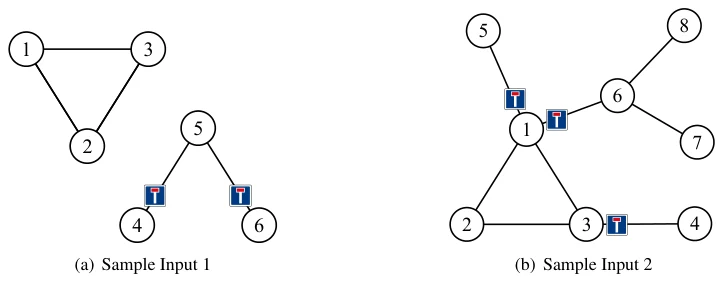
Figure E.1: Illustration of sample inputs, indicating where non-redundant dead-end signs are placed.
Input
The first line of input contains two integers and , where () is the number of locations and () is the number of streets. Each of the following lines contains two integers and () indicating that there is a two-way street connecting locations and . All location pairs in the input are distinct.
Output
On the first line, output , the number of dead-end signs installed. On each of the next lines, output two integers and marking that a dead-end sign should be installed at the -entrance of a street connecting locations and . The lines describing dead-end signs must be sorted in ascending order of -locations, breaking ties in ascending order of -locations.
ICPC World Finals 2019 Problem E: Dead-End Detector
Sample Input 1
6 5
1 2
1 3
2 3
4 5
5 6
Sample Output 1
4 5
6 5
Sample Input 2
8 8
1 2
1 3
2 3
3 4
1 5
1 6
6 7
6 8
Sample Output 2
1 5
1 6
3 4
ICPC World Finals 2019 Problem E: Dead-End Detector
Problem F · Directing Rainfall Time limit: 15 seconds
Porto and the nearby Douro Valley are famous for producing port wine. Wine lovers from all over the world come here to enjoy this sweet wine where it is made. The International Consortium of Port Connoisseurs (ICPC) is organizing tours to the vineyards that are upstream on the Douro River. To make visits more pleasurable for tourists, the ICPC has recently installed sun tarps above the vineyards. The tarps protect tourists from sunburn when strolling among the vines and sipping on a vintage port.
Unfortunately, there is a small problem with the tarps. Grapes need sunlight and water to grow. While the tarps let through enough sunlight, they are entirely waterproof. This means that rainwater might not reach the vineyards below. If nothing is done, this year’s wine harvest is in peril!
The ICPC wants to solve their problem by puncturing the tarps so that they let rainwater through to the vineyards below. Since there is little time to waste before the rainy season starts, the ICPC wants to make the minimum number of punctures that achieve this goal.
We will consider a two-dimensional version of this problem. The vineyard to be watered is an interval on the -axis, and the tarps are modeled as line segments above the -axis. The tarps are slanted, that is, not parallel to the - or -axes (see Figure F.1 for an example). Rain falls straight down from infinitely high. When any rain falls on a tarp, it flows toward the tarp’s lower end and falls off from there, unless there is a puncture between the place where the rain falls and the tarp’s lower end–in which case the rain will fall through the puncture instead. After the rain falls off a tarp, it continues to fall vertically.
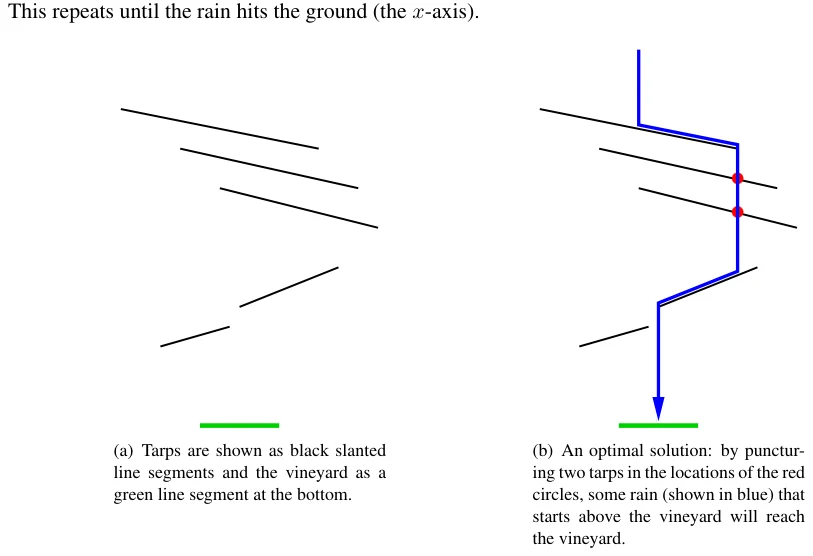
Figure F.1: Illustration of Sample Input 1.
For legal reasons you have to ensure that at least some of the rain that reaches the vineyard originated from directly above the vineyard. This is to prevent any vineyard from stealing all their rain from neighboring vineyards (see the second sample input for an example).
ICPC World Finals 2019 Problem F: Directing Rainfall
Input
The first line of input contains three integers , and , where () is the interval representing the vineyard and () is the number of tarps. Each of the following lines describes a tarp and contains four integers , , , , where is the position of the tarp’s lower end and is the position of the higher end (, , and ).
The -coordinates given in the input (, , and the values of and for all tarps) are all distinct. The tarps described in the input will not intersect, and no endpoint of a tarp will lie on another tarp.
Output
Output the smallest number of punctures that need to be made to get some rain falling from above the vineyard to the vineyard.
Sample Input 1
10 20 5
32 50 12 60
30 60 8 70
25 70 0 80
15 30 28 40
5 20 14 25
Sample Output 1
Sample Input 2
2 4 2
3 2 0 3
5 2 1 5
Sample Output 2
ICPC World Finals 2019 Problem F: Directing Rainfall
Problem G · First of Her Name Time limit: 10 seconds
In the Royal Family, names are very important! As the Royal Historian you have been charged with analyzing the patterns in the names of the Royal Ladies in the realm.
There have been Royal Ladies, for convenience numbered from to . The name of each Lady is an uppercase letter concatenated with the name of her mother. The exception is the Lady numbered , the founder of the Royal Family, whose name is just a single uppercase letter.
For example, ENERYS could be the mother of AENERYS (as the name AENERYS consists of the single uppercase letter ‘A’ concatenated with ENERYS, which is her mother’s name). Similarly, AENERYS could be the mother of DAENERYS and YAENERYS.
You are given the description of all the Royal Ladies. Your task is to determine, for certain interesting strings , the number of Royal Ladies for whom is a prefix of their name.
For example, consider Sample Input 1 below, with a Royal Line that goes straight from the founder S to AENERYS (through YS, RYS, ERYS, NERYS and ENERYS), with each Lady having exactly one daughter. Then AENERYS has two daughters–DAENERYS and YAENERYS, with the latter having one daughter, RYAENERYS.
In such a family, RY is a prefix of the names of two ladies: RYS and RYAENERYS. E is a prefix of the names of ERYS and ENERYS. N is a prefix only of NERYS’s name, while S is a prefix only of the name of the founder, S. AY is not a prefix of any Royal Lady’s name.
Input
The first line of input contains two integers and , where () is the total number of Royal Ladies and () is the number of query strings.
Then follow lines describing the Royal Ladies. The th of these lines describes the Royal Lady num- bered , and contains an uppercase letter (‘A’–‘Z’) and an integer , where is the first letter of the name of Lady , and ( and for ) is the number of her mother (or , in the case of the First Lady). All the names are unique.
The remaining lines each contain one nonempty query string, consisting only of uppercase letters. The sum of the lengths of the query strings is at most .
Output
Output lines, with the th line containing the number of Royal Ladies who have the th query string as a prefix of their name.
ICPC World Finals 2019 Problem G: First of Her Name
Sample Input 1
10 5
S 0
Y 1
R 2
E 3
N 4
E 5
A 6
D 7
Y 7
R 9
RY
E
N
S
AY
Sample Output 1
0ICPC World Finals 2019 Problem G: First of Her Name
Problem H · Hobson’s Trains Time limit: 5 seconds
Mr. Hobson has retired from running a stable and has invested in a more modern form of transport, trains. He has built a rail network with stations. However, he has retained his commitment to free the passenger from the burden of too many choices: from each station, a passenger can catch a train to exactly one other station. Such a journey is referred to as a leg. Note that this is a one-way journey, and it might not be possible to get back again.
Hobson also offers exactly one choice of ticket, which allows a passenger to travel up to legs in one trip. At the exit from each station is an automated ticket reader (only one, so that passengers do not need to decide which to use). The reader checks that the distance from the initial station to the final station does not exceed legs.
Each ticket reader must be programmed with a list of valid starting stations, but the more memory this list needs, the more expensive the machine will be. Help Hobson by determining, for each station , the number of stations (including ) from which a customer can reach in at most legs.
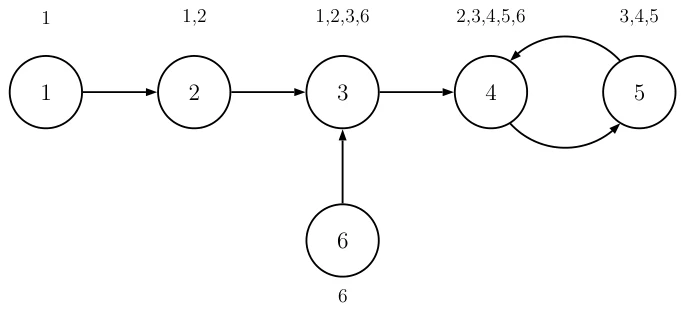
Figure H.1: Illustration of Sample Input 1. Each circle represents a station. The numbers outside the circles are the station numbers loaded into the ticket readers when .
Input
The first line of input contains two integers and , where () is the number of stations and () is the maximum number of legs that may be traveled on a ticket. Then follow lines, the th of which contains an integer ( and ), the station which may be reached from station in one leg.
Output
Output lines, with the th line containing the number of stations from which station can be reached in at most legs.
ICPC World Finals 2019 Problem H: Hobson’s Trains
Sample Input 1
6 2
5
Sample Output 1
5Sample Input 2
5 3
5
Sample Output 2
ICPC World Finals 2019 Problem H: Hobson’s Trains
Problem I · Karel the Robot Time limit: 10 seconds
Did you know that the word “robot” is almost years old? It was first introduced in , in the science-fiction theatrical play R.U.R., written by Karel ˇCapek. As a tribute to this Czech writer, an educational programming language was named Karel many years later at Stanford University. Your task is to implement an interpreter of a simplified version of this programming language.
The Karel programming language controls a robot named Karel, who lives in a grid of unit squares. Some of the squares are free, while others contain a barrier. Karel always occupies one of the free squares and faces one of the four cardinal directions. The two basic commands are “move forward” and “turn left.” The language also provides simple conditional and looping statements. The main educational potential of the language lies in the possibility of defining new procedures for more complex tasks.
Our simplified version of the language can be described by the following grammar:
<program>
            :=
                "" | <command> <program>
<command>
            :=
                "m" | "l" | <proc-call> |
                "i" <condition> "(" <program> ")(" <program> ")" |
                "u" <condition> "(" <program> ")"
<condition> :=
                "b" | "n" | "s" | "e" | "w"
<proc-call> :=
                <uppercase-letter>
<proc-def>
            :=
                <uppercase-letter> "=" <program>
There are five types of commands:
m (“move forward”) advances Karel’s position by one grid square in its current heading, unless there is a barrier, in which case the command has no effect.
l (“turn left”) makes Karel turn left degrees.
X where X is any uppercase letter, invokes the procedure named X.
i (“if”) followed by a single-letter condition, and two programs in parentheses. If the condition is satisfied, the first program is executed. Otherwise, the second program is executed.
u (“until”) followed by a single-letter condition, and a program in parentheses. If the condition is satisfied, nothing is done. Otherwise, the program is executed and then the command is repeated.
A condition can be either ‘b’, which is satisfied if and only if there is a barrier in the next square in Karel’s current heading, or one of the four directional letters ‘n’, ‘s’, ‘e’, or ‘w’, which is satisfied if and only if Karel’s current heading is north, south, east, or west, respectively.
For instance, a simple program ub(m) can be understood to mean: “keep moving forward until there is a barrier,” while un(l) means “turn to the north.” A procedure definition R=lll defines a new procedure ‘R’ which effectively means “turn right.”
Input
The first line of input contains four integers , , , and , where and () are the dimensions of the grid in which Karel lives, () is the number of procedure definitions, and () is the number of programs to be executed.
ICPC World Finals 2019 Problem I: Karel the Robot Then follow lines describing the grid (running north to south), each containing characters (running west to east), each character being either ‘.’ (denoting a free square) or ‘#’ (denoting a barrier). All squares outside this given area are considered barriers, which means Karel may never leave the area.
Each of the next lines contains a procedure definition, associating a procedure name (one uppercase letter) with a program forming the procedure body. No procedure name is defined more than once. Procedure bodies may contain invocations of procedures that have not yet been defined.
The last lines describe the programs to be executed. Each such description consists of a pair of lines. The first line of each pair contains two integers and and a character , where () is the row and () is the column of Karel’s initial position, and n s e w represents Karel’s initial heading. It is guaranteed that the initial position is a free square. The second line of each pair contains a program to be executed from that initial position.
All procedure bodies and all programs to be executed are at least and at most characters long, syn- tactically correct, and only contain invocations of procedures that are defined. The lines with procedure definitions and programs to be executed contain no whitespace characters.
Output
For each program execution, output the final position of Karel after the complete program is executed from the respective initial position. Follow the format used to describe initial positions, that is, two numbers and a directional character. If a particular execution never terminates, output inf instead.
Sample Input 1
4 8 5 7
.......#
..#....#
.###...#
.....###
R=lll
G=ub(B)
B=ub(m)lib(l)(m)
H=ib()(mmHllmll)
I=III
1 1 w
G
1 1 e
G
2 2 n
G
2 6 w
BR
4 1 s
ib(lib()(mmm))(mmmm)
1 1 e
H
2 2 s
I
Sample Output 1
1 1 w
inf
1 1 w
2 4 s
4 4 e
1 4 e
inf
ICPC World Finals 2019 Problem I: Karel the Robot
Problem J · Miniature Golf Time limit: 6 seconds
A group of friends has just played a round of miniature golf. Miniature golf courses consist of a number of holes. Each player takes a turn to play each hole by hitting a ball repeatedly until it drops into the hole. A player’s score on that hole is the number of times they hit the ball. To prevent incompetent players slowing down the game too much, there is also an upper limit (a positive integer) on the score: if a player has hit the ball times without the ball dropping into the hole, the score for that hole is recorded as and that player’s turn is over. The total score of each player is simply the sum of their scores on all the holes. Naturally, a lower score is considered better.
There is only one problem: none of the players can remember the value of the integer . They decide that they will not apply any upper limit while playing, allowing each player to keep playing until the ball drops into the hole. After the game they intend to look up the value of and adjust the scores, replacing any score on a hole that is larger than with .
The game has just finished, but the players have not yet looked up . They wonder what their best possible ranks are. For this problem, the rank of a player is the number of players who achieved an equal or lower total score after the scores are adjusted with . For example, if the adjusted scores of the players are , , , , and , then their ranks are , , , and respectively.
Given the scores of the players on each hole, determine the smallest possible rank for each player.
Input
The first line of input contains two integers and , where () is the number of players and () is the number of holes. The next lines each contain positive integers. The th number on the th of these lines is the score for player on hole , and does not exceed .
Output
Output a line with the minimum possible rank for each player, in the same order as players are listed in the input.
Sample Input 1
3 3
2 2 2
4 2 1
4 4 1
Sample Output 1
Sample Input 2
6 4
3 1 2 2
4 3 2 2
6 6 3 2
7 3 4 3
3 4 2 4
2 3 3 5
Sample Output 2
5
5
ICPC World Finals 2019 Problem J: Miniature Golf
Problem K · Traffic Blights Time limit: 2 seconds
Cars! Where do they come from? Where do they go? Nobody knows. They appear where roads have been built, as if out of nowhere. Some say that no two cars are alike. Some say that if you look closely, you can see the pale ghosts of miserable humans inside them, trapped forever–particularly in the morning and late afternoon. What scientific eye could frame their fearful symmetry?
Well, yours, hopefully. As part of your government’s Urban Traffic Control department, you are trying to write a paper on local traffic congestion. It is too dangerous to observe cars in the wild, of course, but you have been given some data on the traffic lights along your town’s Main Street, and you would like to do some theoretical calculations about how well-synchronized they are.
Main Street is set out on a line, with traffic lights placed at various points along it. Each traffic light cycles between red and green with a fixed period, being red for seconds, then green for seconds, then red for seconds, and so on. The values of and may be different for different traffic lights. At time , all the lights have just turned red.
Assume that an “ideal” car mystically appears at the west end of Main Street at a uniformly random real-valued time in the interval (where is the product of the first positive integers), driving eastwards at a slow crawl of meter/second until it hits a red light. What is the probability that it will make it through all the lights without being forced to stop? If it does hit a red light, which one is it likely to hit first?
Write a program to answer these questions.
Input
The first line of input contains an integer (), the number of traffic lights. Each of the following lines contains three integers , , and describing a traffic light, where () is the position of the light along Main Street in meters, and and ( and ) are the durations in seconds of the red and green portions of the light’s period (so the light is red from time to , from time to , and so on).
The west end of Main Street is at position , and the lights are listed in order of strictly increasing position.
Output
For each of the lights, output a line containing the probability that this light will be the first red light an “ideal” car hits. Then output a line containing the probability that an “ideal” car makes it all the way without stopping. Your answers should have an absolute error of at most .
Sample Input 1
1 2 3
6 2 3
10 2 3
16 3 4
Sample Output 1
0.4
0
0.2
0.171428571429
0.228571428571
ICPC World Finals 2019 Problem K: Traffic Blights
Sample Input 2
6
4 1 5
9 8 7
13 3 5
21 5 7
30 9 1
2019 20 0
Sample Output 2
0.166666666667
0.466666666667
0.150000000000
0.108333333333
0.091666666667
0.016666666667
0.000000000000
ICPC World Finals 2019 Problem K: Traffic Blights